
The technology behind household appliances has advanced by leaps and bounds in recent decades, largely thanks to the use of innovative materials, particularly plastics.
At Walterpack, we are well-versed in working with polymers. Today, we discuss which plastics are used for household appliances, the most common types, and their key properties. Keep reading!
Types of Plastics Used in Household Appliances
Plastics for household appliances must **meet several criteria**, such as heat resistance, durability, flexibility, and the ability to be molded into specific shapes.
Here are the most common types used in manufacturing these electronic devices:
ABS (Acrylonitrile Butadiene Styrene)
Acrylonitrile Butadiene Styrene (ABS) is an **amorphous thermoplastic polymer composed of three monomers**: acrylonitrile, butadiene, and styrene. This material combines the unique properties of each component to create a blend of rigidity, toughness, impact strength, and flexibility.
Acrylonitrile provides thermal and chemical resistance.
Butadiene, an elastomer, offers elasticity and exceptional impact absorption.
Styrene adds rigidity, ease of processing, and a smooth, shiny surface finish.
Structurally, ABS features a heterogeneous microstructure, where butadiene particles are distributed in an acrylonitrile-styrene matrix. This configuration provides high mechanical strength and the ability to withstand deformation without cracking.
Polypropylene (PP)
Polypropylene is a **semi-crystalline thermoplastic polymer** obtained from the polymerization of propylene, a hydrocarbon monomer derived from petroleum. It is one of the most widely used plastics in household appliances due to its balance of mechanical properties, thermal resistance, and relatively low cost.
Polypropylene’s chemical structure consists of long chains of propylene monomers arranged in an orderly fashion, giving it its semi-crystalline nature. This organization provides high tensile strength and resistance to deformation.
Additionally, it is heat-resistant, tolerating temperatures over 100°C without significant deformation, making it ideal for components exposed to moderate heat or hot water.
Polystyrene (PS)
Polystyrene is a **thermoplastic polymer derived from styrene monomer**, an unsaturated liquid hydrocarbon. It is one of the most popular plastics due to its ease of production.
It comes in two main forms: General Purpose Polystyrene (GPPS) and Expanded Polystyrene (EPS):
- General Purpose Polystyrene is rigid, transparent, and brittle, used in applications requiring optical clarity and dimensional stability but with low impact resistance. Its molecular structure is linear, facilitating processing through injection molding and extrusion.
- Expanded Polystyrene is a foam version created by adding a blowing agent during polymerization. The result is a lightweight material with excellent thermal insulation and impact absorption properties.
Despite its limitations in terms of heat and impact resistance in solid form, PS is widely used due to its **low cost** and **ease of processing**. 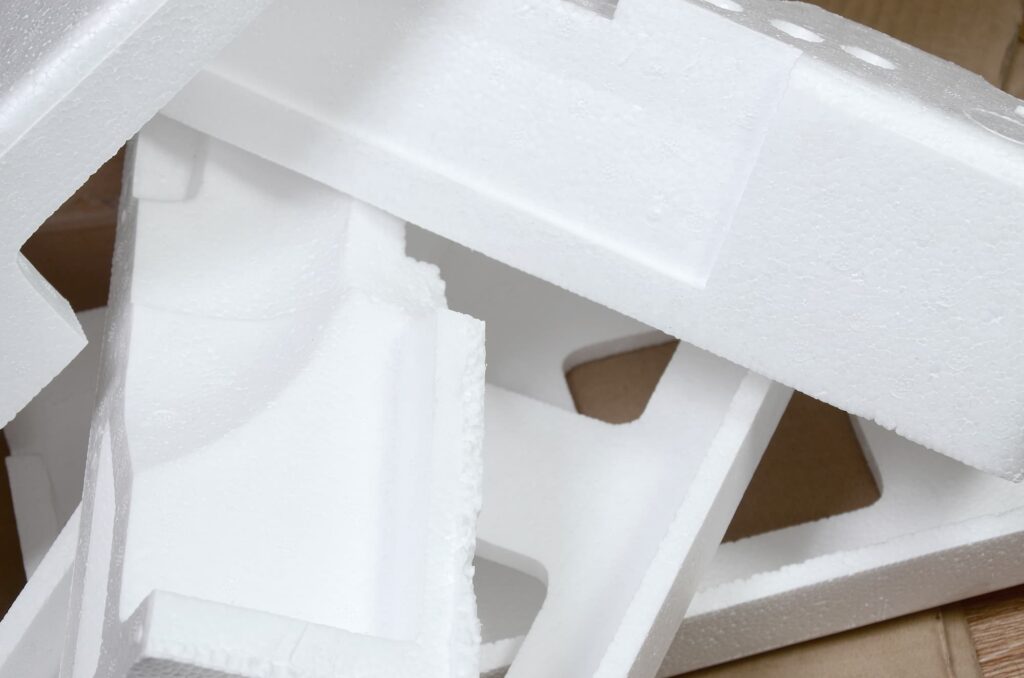
Key Properties of Plastics for Household Appliances
Plastics used in household appliances must meet specific key properties to **ensure durability and safety** of the devices.
Below are the most important characteristics:
- Heat resistance: Appliances that generate or come into contact with heat, such as ovens and microwaves, require materials with good thermal resistance. Common options include polypropylene and certain types of nylon.
- Impact resistance: Washing machines and dryers are subject to constant vibrations and impacts during use. Therefore, plastics like ABS, which can withstand impacts without cracking, are utilized.
- Electrical insulation: Plastics are inherently insulating, making them suitable for electrical devices. Their ability to prevent electrical conduction ensures safety.
- Durability and longevity: Polymers used in household appliances must be durable and able to withstand daily wear, including resistance to chemicals, abrasion, and prolonged sun exposure.
- Moldability: Plastics’ ability to be molded into complex shapes allows manufacturers to create more ergonomic and efficient designs.
Specialized Plastics for Household Appliances
In addition to common plastics like ABS, polypropylene, and polystyrene, there are **other types used in specific applications** within electronic devices:
- Polycarbonate (PC): Known for its transparency and high impact tolerance, it is used in transparent doors for ovens, microwaves, and blender lids.
- Polyamide (PA or Nylon): Nylon is highly durable and has great thermal stability, making it ideal for components exposed to high temperatures and friction.
- Polyurethane (PU): Mainly used as insulating foam in electrical appliances like refrigerators and freezers, its thermal insulation capabilities help maintain constant internal temperatures.
Plastics for household appliances play a vital role in the **durability**, **efficiency**, and **design** of the devices we use daily. Materials like ABS, polypropylene, and polystyrene provide the strength needed to withstand impacts and enable the creation of lighter, moldable, and functional products.
If you have a proposal or project to carry out, contact Walterpack. We have over 30 years of experience designing functional components.
Frequently Asked Questions (FAQ)
Finally, let’s address some of the most common questions about plastics for household appliances:
Is ABS plastic recyclable?
Yes, **Acrylonitrile Butadiene Styrene is recyclable**. However, its recycling process is more complex compared to other plastics due to its composition. ABS must be sorted and processed properly to avoid contamination with other plastic materials.
Which plastics are most heat-resistant for household appliances?
The most heat-resistant plastics used in household appliances are **Polypropylene (PP)** and **Polyamide (PA or Nylon)**. Both materials can withstand high temperatures without losing their structural integrity.
What are the advantages of polypropylene in household appliances?
Polypropylene offers several advantages for manufacturing household appliances. Firstly, it is a **chemically resistant** and **thermally insulating** material. It is also a **recyclable plastic**, making it a sustainable option for manufacturers aiming to reduce environmental impact.